
Is It Time to DExit? A Guide for Boards

Is It Time to DExit? A Guide for Boards

Is It Time to DExit? A Guide for Boards
The domicile question is no longer academic. It is a boardroom decision with real capital markets consequences. This three-part series delves into the background, issues, mechanics and considerations for stakeholders to assess when considering reincorporating outside of Delaware. This first article covers these issues from the perspective of a board of directors; the second part will examine these issues using an investor lens; and the third part will feature a conversation among certain of our authors and presented as part of Akin’s podcast series “The Business Court Benches”.
Executive Summary & Key Takeaways for Boards
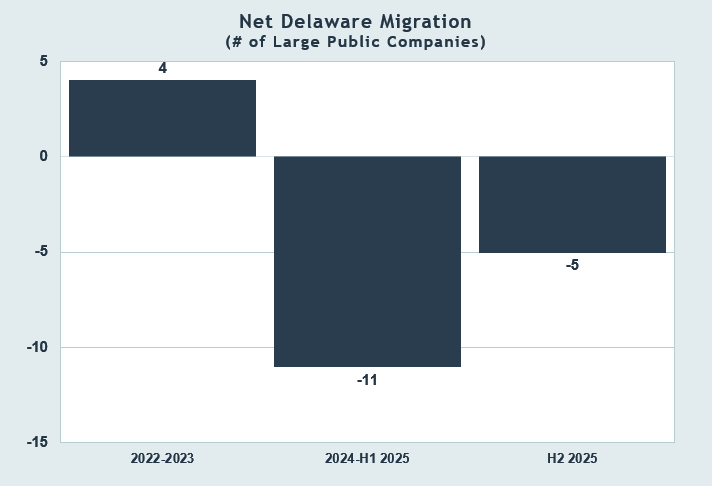
Delaware lost 16 large public companies to reincorporation from 2024 through the first half of 2025; a sharp reversal from the net gain of four companies in 2022–20231. Its share of large initial public offering (IPO) incorporations fell to 77% in 2025, from over 80% in 2022-20242. This corporate migration, known as “DExit”, was driven, in part, by the U.S. Securities and Exchange Commission’s (SEC) September 2025 policy statement permitting mandatory shareholder arbitration in corporate charters. In response, Delaware enacted legislation prohibiting these provisions. Meanwhile, Texas and Nevada have adopted legislation permitting such provisions, as well as other legislative changes that have generally operated to expand corporate governance protections for boards of directors.
Nearly a year after those watershed moments, it is time to assess the reincorporation landscape, including the divergent risks of key corporate stakeholders, the mechanics of redomiciling and practical takeaways for market participants.
Key takeaways and best practices for boards of directors considering whether to reincorporate include:
- Engage counsel early to ensure the board adequately understands the benefits and considerations, on a comparative basis, of the destination jurisdiction.
- Capital markets mechanics demand expert execution: SEC filings, regulatory coordination, consent requirements and insurance restructuring are not ministerial.
- The path from announcement to completion is complex, multi-regulatory and unforgiving of sequencing errors.
- Engage transaction counsel, proxy solicitors and insurance advisors well in advance of any public announcement.
- Understand statutory voting threshold requirements and identify where key shareholder voting blocs are located.
- Document the business rationale for reincorporation contemporaneously.
- Study successful playbooks and determine what was effective and replicable from those campaigns.
- Expect competitive dynamics among Delaware, Texas and Nevada to intensify, requiring stakeholders to monitor legislative and regulatory developments.
How Did We Get Here?
From 2020 through 2023, reincorporation was a rare event, with just a handful of issuers per year electing to reincorporate outside of Delaware. Beginning in 2024 and accelerating through 2025 following the issuance of the SEC’s September 2025 policy statement and legislative enactments in Delaware and Texas, reincorporation volumes increased to a recognizable institutional trend. In 2025 alone, boards submitted 26 reincorporation proposals. During 2025, 21 proposals received stockholder approval by vote and an additional seven were approved by written consent. As of mid-April 2026, Texas had already exceeded its full-year 2025 count. The following chart depicts the recent reincorporation flows.
Broadly speaking, four developments have converged to ignite this reincorporation trend:
- High-profile companies have challenged Delaware’s gravitational pull. Tesla’s reincorporation to Texas may be viewed as a symbolic starting point, framed as a response to perceived overreach in Delaware corporate law following a series of Delaware Court of Chancery decisions that fueled concerns among founders, directors and controlling stockholders about governance matters, litigation risk and judicial intervention.
- The SEC changed the securities-litigation calculus. The SEC’s September 2025 policy statement removed the federal regulatory obstacle to mandatory shareholder arbitration provisions; although enforceability, investor reaction and state-law questions remain unresolved.
- Delaware responded. The 2025 Delaware General Corporation Law (DGCL) amendments addressed predictability for interested transactions, controller transactions, director independence and books-and-records demands, but simultaneously banned mandatory arbitration.
- Texas and Nevada sharpened their pitch. Texas SB 29 codified, among other things, business judgment protections, derivative thresholds, jury waivers and exclusive forum provisions. Nevada AB 239 clarified controlling-stockholder duties and offered opt-out director and officer (D&O) liability defaults.
The result: DExit is not a stampede, but it is now a live governance, litigation, capital markets and investor-relations issue for public company boards. That said, the question now is whether reincorporation was, and continues to be, the right move.
The Competitive Landscape: Delaware, Texas, Nevada and the Cayman Islands
While this alert focuses primarily on the Delaware-to-Texas reincorporation path (i.e., the most common migration destination for large public companies), Nevada and the Cayman Islands also feature prominently. Notably, there are several similarities and differences among these jurisdictions in relation to the incorporation or reincorporation question. The table below provides a high-level summary of some of the key jurisdictional features that should be evaluated as a board determines whether or not to undertake incorporation or reincorporation (as the case may be), each of which is explained in more detail below.
Comparative Jurisdiction Summary
|
Feature |
Delaware |
Texas (SB 29) |
Nevada (AB 239) |
Investor Concern |
|
Business Judgement Standard |
Common-law presumption; well-developed case law |
Codified statutory safe harbor with presumption of compliance |
Statute-based; liability requires intentional misconduct, fraud or knowing violation |
Texas/Nevada standards may limit shareholder ability to challenge conflicted transactions |
|
Mandatory Arbitration |
Prohibited |
Permitted |
Permitted |
Texas/Nevada standard eliminates class actions; confidentiality limits precedent and accountability |
|
Derivative Suit Threshold |
Single share (common law) |
Up to 3% ownership minimum (charter opt-in) |
No statutory minimum |
3% threshold effectively bars most institutional investors from bringing derivative claims |
|
Books & Records Access |
Section 220; emails available upon compelling need |
Excludes emails, texts, social media |
Similar to Delaware |
Texas standard means reduced transparency for activist and governance-focused investors |
|
Forum Selection |
Permitted (Salzberg) |
Texas Business Court or other Texas courts |
Nevada courts |
Texas and Nevada are unfamiliar courts with limited corporate precedent |
|
D&O Exculpation |
Opt-in charter provision (Section 102(b)(7)) |
Follows Delaware model |
Opt-out default; broader coverage |
Nevada default eliminates board accountability for negligence absent specific carve-out |
Texas: What Boards May Find Attractive
Texas’s enactment of SB 29 and the establishment of the Texas Business Court (launched in September 2024, with judges specializing in complex commercial matters) reflect a broader state initiative to offer front-end clarity and predictability for corporate decision-makers. SB 29 and other relevant legislation aim to make Texas a credible public-company domicile by codifying protections around business judgment, derivative claims, shareholder proposals, jury waivers and internal corporate affairs. We previously wrote about SB 29 here; however, key features include:
- Codified the business judgment rule. The statute formally codifies the business judgment rule, providing directors with a safe harbor from personal liability for decisions made in good faith, on an informed basis, in furtherance of the corporation’s interests and in obedience to law and governing documents. For publicly traded entities or entities that opt-in, it also creates a presumption that directors and officers have acted in accordance with those requirements, shifting the burden to plaintiffs to demonstrate that the (i) act or omission was a breach of the person’s duties as a director or officer and (ii) the breach resulted from, among other things, fraud or intentional misconduct. Delaware’s business judgment rule, by contrast, is primarily a creature of common law and may be subject to modification through case-by-case development3. For other entities (e.g., limited liability companies), SB 29 permits the governing documents to expand or eliminate fiduciary duties and corresponding liabilities.
- Exclusive forum provisions. SB 29 permits corporations to designate the Texas Business Court or other Texas courts as the exclusive venue for resolving disputes, resulting in mandatory application of Texas’s business code provisions.
- Jury trial waivers. The law authorizes corporations to include waivers of the right to a jury trial in their governing documents, aligning Texas more closely with the bench-trial model of the Delaware Court of Chancery. Jury trial waivers under SB 29 relate to “internal entity claims” (i.e., “a claim of any nature, including a derivative claim in the right of an entity, that is based on, arises from or relates to the internal affairs of the entity”4). We note that the validity of this provision in SB 29 remains untested at this time against Texas’s conflicting constitutional right to a jury trial. As a result, companies considering adding a jury trial waiver to governing documents should do so mindful that the question of the enforceability of such waivers is unresolved and likely subject to future litigation.
- Derivative suit ownership thresholds. Unlike Delaware, Texas now permits publicly listed corporations with (i) 500 or more shareholders and (ii) that have affirmatively opted in the statutory presumption that directors and officers have discharged the fiduciary responsibilities, to set minimum ownership percentages required for a shareholder to bring a derivative lawsuit, a mechanism that can significantly reduce the volume of strike suits. That minimum ownership percentage may be set at up to 3% of the corporation’s issued and outstanding shares.
- Limitations on Attorney Fee Awards. SB 29 sets limitations on the amount of attorney fees that may be awarded in derivative litigation, requiring such fees to be justified by the attorney(s) having realized a substantial benefit to the company through the litigation. Notably, modified or enhanced disclosures to stakeholders, a customary remedy in these matters, are not considered a “substantial benefit” for these purposes.
- Reviewing Related Party Transactions. SB 29 creates a novel mechanism allowing Texas public companies to obtain a judicial determination in advance that a special committee reviewing a related-party or control transaction is independent. Following expedited proceedings and an evidentiary hearing, the Texas Business Court may issue a binding ruling on the committee’s independence. Absent previously undisclosed facts, that determination is dispositive, providing companies and directors with greater certainty when navigating potentially or actually conflicted transactions.
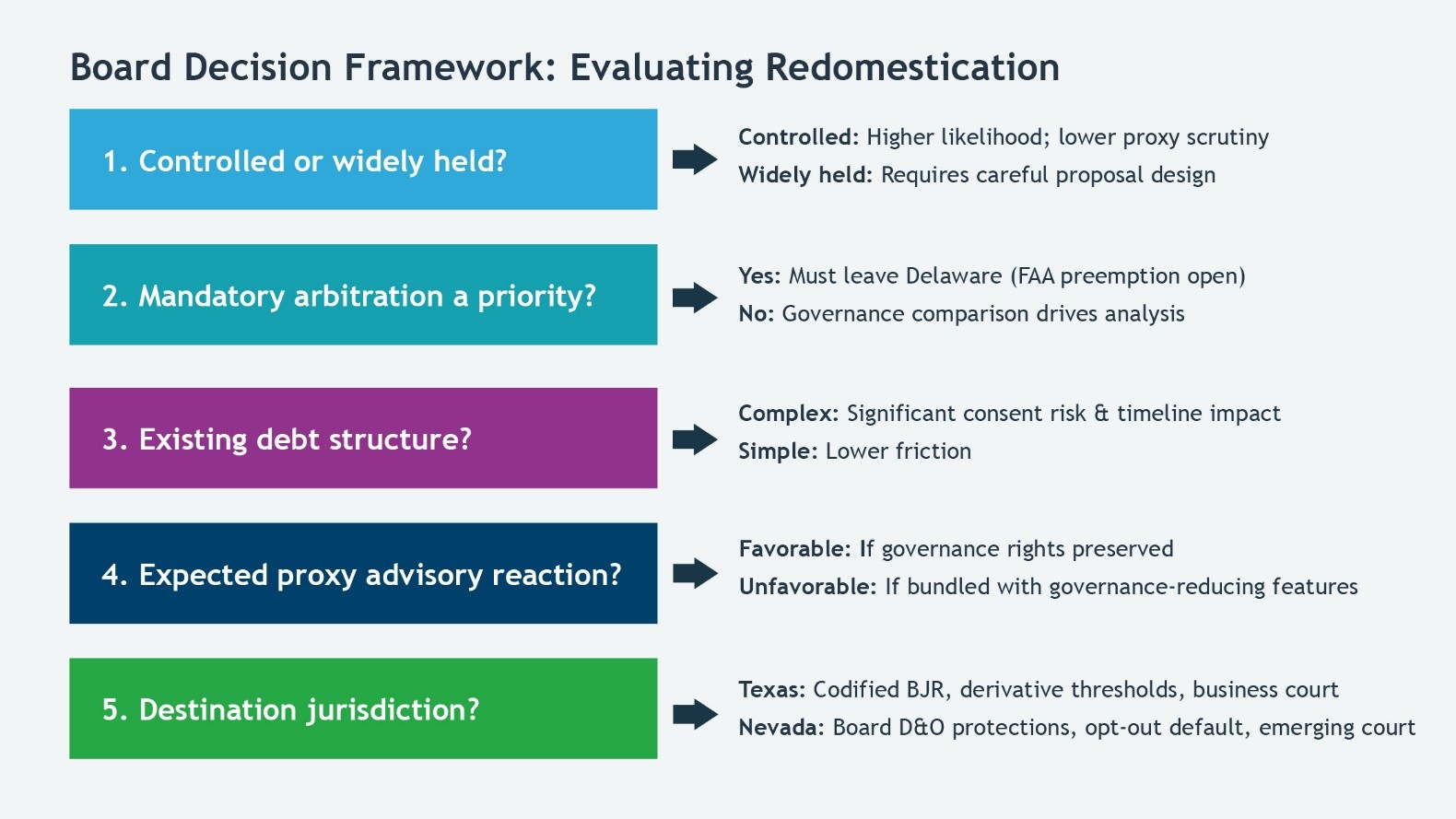
Despite these business-friendly features, there are questions for directors to consider as they evaluate reincorporation. The following table enumerates several of these considerations.
Nevada and Cayman Islands: Additional Considerations
Nevada has emerged as a significant competitor alongside Texas when it comes to attracting businesses away from Delaware. In May 2025, Nevada’s legislature adopted Assembly Bill 239, which clarifies the fiduciary duties of controlling stockholders, permits corporations to waive jury trials in their articles of incorporation and allows certain holding company reorganizations. Nevada’s existing statutory framework already provides broad director and officer protections: liability requires a showing of intentional misconduct, fraud or a knowing violation of law, a standard that, unlike the DGCL’s 102(b)(7) exculpation, applies as an opt-out default rather than an opt-in election. Nevada is also pursuing a dedicated business court through a pilot program expected to become operational in the third quarter of 2026. Several high-profile companies have reincorporated, are reincorporating or have announced plans to consider reincorporating to Nevada.
The Cayman Islands is relevant primarily in the special purpose acquisition company (SPAC) context5. Of the 26 reincorporation proposals that went to a vote in the second half of 2025, 10 involved SPACs or other business combinations and seven of those reincorporated from the Cayman Islands to Delaware, typically into as part of the de-SPAC transaction. For capital markets practitioners, this inbound flow is the mirror image of the domestic DExit trend. Institutional investors and commentators have noted that the Cayman Islands offers weaker investor protections compared to any U.S. jurisdiction6.
Reincorporation: A Snapshot of the Mechanics and the Approaches That Have Worked
A reincorporation structured as a statutory merger triggers a series of securities-law and regulatory processes with cost, timeline, sequencing and risk implications requiring careful coordination. For instance, boards and management will need to ensure that they have analyzed the shareholder base against appliable voting thresholds and identified significant shareholder voting blocs requiring engagement. Importantly, the mechanics vary by charter, bylaws, exchange rules, capital structure and investor profile, but the principal workstreams typically include:
|
Workstream |
Timeline |
Key Considerations |
|
SEC Filings (e.g., Proxy Statement / Form S-4) |
4–12 weeks |
Proxy statement (and sometimes Form S-4); material differences disclosure; SEC comment process |
|
FINRA/Exchange Notifications |
2–4 weeks |
Corporate action notice; potential independent shareholder approval; sequencing with SEC filings |
|
Debt Instrument Consents |
30–60 days |
Change-of-control triggers; successor obligor provisions; multi-series coordination |
|
D&O Insurance |
60+ days pre-announcement |
Policy definitions; prior-acts coverage; tail coverage; successor underwriting |
|
Blue Sky Compliance |
Concurrent |
Preempted for listed securities; may be relevant for other securities of the issuer |
The success or failure of a reincorporation proposal at the shareholder vote stage depends significantly on the positions taken by proxy advisory firms and institutional investors7. Boards and their advisors should factor these dynamics into their planning from the outset. Among recent successful reincorporations, certain tactics and approaches stand out. Specifically:
- Shareholders have tended to approve reincorporation proposals, including over the objections by proxy advisory firms, where they are structured to preserve existing governance rights, or at minimum, when governance-reducing features are separated into distinct vote items.
- Where a reincorporation proposal is anticipated to be hotly contested, develop and implement a robust voting campaign, including an aggressive shareholder engagement program, using proxy supplements to contest adverse proxy advisor analyses and an advertising campaign across multiple platforms and channels.
- Understand applicable jurisdictional voting thresholds and work with advisors to model shareholder votes carefully and with a clear understanding of what is required for passage.
- Boards should also be attentive to the political dimension of institutional voting. Large asset managers, which hold significant positions across the public company universe, may face political considerations that influence their voting on reincorporation proposals, particularly those involving Texas as the destination state and high-profile issuers.
- The current political and regulatory environment may also influence investor voting dynamics. For instance, major asset managers have faced significant scrutiny from state officials and other stakeholders regarding environmental, social and governance (ESG)-related voting and stewardship activities, prompting observable shifts in proxy voting practices8. Against that backdrop, some investors may be less inclined to oppose reincorporation proposals on governance grounds alone, where doing so could be perceived as inconsistent with broader political, regulatory or fiduciary narratives regarding shareholder value maximization and corporate governance.
Conclusion: The New Default
DExit is not a referendum on Delaware alone. It is a referendum on corporate-law predictability, stockholder litigation, founder and controller flexibility, board authority and investor rights. For companies, the best approach is disciplined and company-specific: build the record, assess alternatives, understand investor reaction and avoid overreaching. The new default is not Texas or Nevada. The new default is that considering a new domicile deserves a board-level answer.
1 See, e.g., Analysis Group “DExit Trends: Tracking Reincorporations Away from Delaware” and Analysis Group “DExit: Reincorporation Data Seem to Support the Hype” (as republished by The Harvard Law School Forum on Corporate Governance).
2 Id.
3 See, e.g., Aronson v. Lewis, 473 A.2d 805, 812 (Del. 1984) (describing the business judgment rule as a presumption) overruled on other grounds by Brehm v. Eisner, 746 A.2d 244 (Del. 2000); and Maffei v. Palkon, 339 A.3d 705 (Del. 2025) (clarifying application of business judgment review in the reincorporation context).
4 Tex. Bus. Orgs. Code §2.115.
5 SPACs are sometimes formed in the Cayman Islands because Cayman law provides a tax-neutral jurisdiction that facilitates capital raising from global investors and minimizes entity-level tax friction during the SPAC’s pre-acquisition phase. Upon consummation of a de-SPAC transaction, however, the combined company often reincorporates to a U.S. jurisdiction (traditionally Delaware, and increasingly Texas or Nevada) for various reasons, including tax-related considerations, as well as to align its corporate domicile with its operating business, investor base and long-term governance objectives.
6 Section 1.8 of the “Policies on Corporate Governance” published by The Council of Institutional Investors reads that “[C]ompanies should incorporate in jurisdictions with strong investor rights and protections. Companies should not reincorporate in jurisdictions where corporate governance structures are less robust than their current jurisdiction of incorporation. Additionally, companies should not adopt new articles of incorporation or bylaws which diminish investor rights and protections in conjunction with reincorporation.”
7 It is worth noting that the major proxy advisory firms have been subject to increasingly close scrutiny from policymakers, regulators, investors and other stakeholders recently. This scrutiny has led some to question the influence these firms continue to have in the marketplace; however, at this time, we believe it is important for companies, boards, management and investors to continue engaging with these firms in order to avoid creating unnecessary issues with a reincorporation proposal.
8 See, e.g., Kalyeena Makortoff, Support for ESG Proposals at Record Low Driven by US Investors, Report Shows, The Guardian (Feb. 18, 2025).
Authors