
UK OFSI Updates Enforcement and Monetary Penalties Guidance

UK OFSI Updates Enforcement and Monetary Penalties Guidance

UK OFSI Updates Enforcement and Monetary Penalties Guidance
Key Takeaways
- On 9 February 2026, the UK’s OFSI released its updated enforcement and monetary penalties guidance, introducing several changes to the enforcement framework, following a 12-week consultation process.
- Key changes include: (i) a new early account scheme to help expedite investigations; (ii) an updated case assessment framework for penalty calculations (including a new focus on the strategic priority of the relevant sanctions regime); (iii) a new settlement scheme with a 20% discount; and (iv) fixed penalties for information and licensing offences.
- OFSI also announced on 29 January 2026, via its blog,1 that it would be doubling the maximum penalty amount for financial sanctions breaches to the greater of £2 million or the total value of the breach. It did not indicate a timeframe for this change, but noted it “requires legislative change and will be brought forward when parliamentary time allows.”
- Firms should be cognizant of: (i) the updates to the guidance, particularly around the varying options available in the event of a breach; and (ii) OFSI’s increased focus on enforcement, in particular on cases which have the greatest deterrent or compliance effect i.e. not always cases of the highest value.
Introduction
On 9 February 2026, the Office of Financial Sanctions Implementation (OFSI) published the revised ‘Financial Sanctions Enforcement and Monetary Penalties Guidance’ (the Guidance2) following publication of its consultation response on 29 January 2026. Our earlier client alert3 addressed the initial proposals set out in the 12-week public consultation.
The new Guidance introduces wide-ranging reforms, which include (among others): (i) a new Early Account Scheme (EAS) to encourage disclosure and expedite the investigation process for potential breaches; (ii) an updated case assessment matrix to provide greater transparency about how cases are assessed by OFSI; (iii) a new settlement scheme to foster greater engagement with OFSI and bring matters to a close on mutually acceptable terms; and (iv) further indicative penalties for specified offences.
Early Account Scheme: 20% Penalty Discount
The EAS introduces a 20% monetary penalty reduction for legal persons (not individuals), in exchange for an early comprehensive factual account of the circumstances of the potential breaches, supported by all relevant materials and evidence. This is a separate process from the settlement scheme. OFSI will not proactively invite subjects to provide early accounts; instead, they must request access to the EAS.
- Requesting Access: Once a subject is notified that they are under investigation, OFSI will include details of the EAS in the notice, giving the subject 15 business days to request access. If a request for access to the EAS is made after OFSI has already issued a substantive request for information (RFI), or where OFSI is investigating a subject that knowingly failed to report suspected breaches, this request is unlikely to be granted.
- Granting Permission: When deciding whether to grant permission, OFSI may consider several factors, including:
- The potential complexity and scope of the investigation.
- The extent to which OFSI already holds the relevant evidence or requires additional information to assess the case.
- Subjective Qualifier: The Guidance has also introduced an important subjective qualifier. When considering an application to access the EAS, OFSI will assess whether the subject can provide a “truthful [and] comprehensive account”.
- Whilst several factors referenced within the Guidance could affect this assessment (e.g. previous involvement in the circumvention of financial sanctions or linked investigations by any other official body), OFSI has noted that the presence of such factors “will not automatically preclude entry to the EAS.”
- Moreover, the Guidance states that: (i) voluntary self-disclosure may be viewed as a positive indication that the firm can be relied upon to give a full account; and (ii) the EAS being conditional on the appointment of an independent third party to undertake the investigation could be a mitigating factor.
- Regulator Co-operation: Where regulated entities are involved, OFSI may engage with the relevant supervisory body before coming to a determination.
- EAS Terms: Where a subject receives consent from OFSI to access the EAS, the subject will have 20 business days to reach an agreement regarding its terms, following which OFSI will issue an EAS letter setting out the agreed terms.
- The terms will include: (i) scope of the investigation; (ii) delivery date of findings (typically six months unless unusually complex); (iii) regular review meetings to monitor progress; (iv) notification of additional breaches; and (v) where a third party is being used for the investigation, an attestation that they were able to produce an account free of interference and with sufficient access to relevant persons and information.
- Mutual termination is available, if there are concerns about the scope, truthfulness or intention to complete a full and honest early account.
- EAS Outcomes: Once OFSI has conducted its assessment, it may decide to: (i) take no further action and close the case; (ii) issue a private warning; (iii) publicly disclose the breach; (iv) impose a monetary penalty; (v) continue with further investigative steps; or (vi) make a referral to law enforcement.
As noted in our earlier client alert, the OFSI consultation paper had proposed to increase the maximum settlement discount from 20% to 40% where the EAS had been used. Whilst the proposal was broadly supported within the consultation response, it has not been adopted within the updated Guidance. OFSI’s decision not to increase the EAS discount may disincentivise firms from engaging in the scheme, particularly small and medium enterprises, which may lack the required resources to conduct an internal investigation. Firms will therefore need to evaluate whether the capped EAS discount, combined with the opportunity to constructively engage with OFSI, outweighs the costs of compliance and any negative media where a breach is publicly disclosed.
Revised Case Assessment Framework: Four-Level Seriousness Model
In line with OFSI’s consultation paper, the Guidance has now updated the case assessment matrix to provide greater transparency on how each case is categorised. OFSI’s assessment considers a range of factors, which are divided into two categories: (i) “severity” (Case factors A – D); and (ii) “conduct” of the subject (Case factors E – H), set out below.
Once the relevant “severity” and “conduct” factors have been considered, the breach will be categorised according to a four-tier seriousness model, which ranges from Level 1 (“Low Severity” and “Mitigating Conduct”) to Level 4 (“High Severity” and “Aggravating Conduct”).
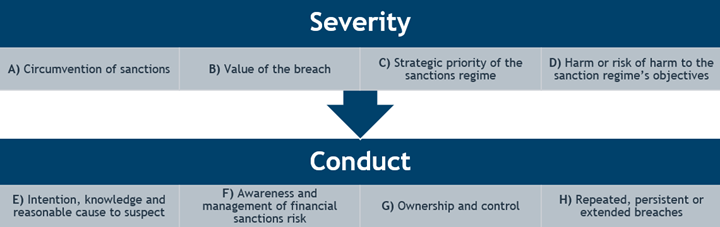
Among the changes made to the case assessment framework, OFSI has removed and added new case factors, which may help firms to identify and understand the severity of a potential breach from an early stage. Notable changes include:
- Strategic priority of the sanctions regime (New Case Factor C): Whether the sanctions regime which has been breached is of particular importance to the UK’s foreign policy and national security. While the Guidance maintains that all sanctions regimes are important, the addition of such factors demonstrates OFSI’s ability to adapt to a dynamic geo-political environment. For country specific sanctions regimes, breaches relating to Russia and Iran sanctions are likely to remain areas of strategic importance to the UK.
- Intention, knowledge and reasonable cause to suspect (New Case Factor E): The Guidance has been updated to reflect changes introduced by the Economic Crime (Transparency and Enforcement) Act 2022, which removed the requirement for a person to have known or suspected that it was acting in breach for offences committed on or after 15 June 2022. However, OFSI will continue to assess the following matters, which include (among others):
- Whether that person “intended” to breach financial sanctions.
- Whether that person knew or had reasonable cause to suspect that their actions would breach financial sanctions.
- Whether there is evidence of recklessness, neglect, willful ignorance and/or bad faith.
- Whether that person should have otherwise known or suspected that their actions would result in a breach of financial sanctions.
OFSI will also consider the seniority and/or role of the persons whose actions led to, or contributed to, the breach.
- Awareness and management of financial sanctions risk (New Case Factor F): OFSI states that it will “assess the sanctions risk controls, systems and processes an individual or entity had in place and whether this was proportionate and reasonable to the circumstances and risks the subject was exposed to”. Failure of regulatory professionals to meet regulatory standards could be an aggravating factor.
- Removal of Prior Case Factors G, H, J, K and L: OFSI has removed prior case factors on failure to apply for a licence, breaching licence terms, professional facilitation, reporting of breaches to OFSI, co-operation and failure to provide information on financial sanctions breaches.
Monetary Penalty Process: 70% Cumulative Penalty Discount
OFSI has amended its penalty threshold assessment by removing consideration of evidence of circumvention, the fact that the breach involves a provision of, or dealing with, funds or economic resources to or from a designated person and a failure to comply with a requirement to provide information.
It has also overall increased the baseline penalty discount available (i.e. 70%) by permitting differing discounts to be applied concurrently (notwithstanding the fact that it has reduced the level of some of the available discounts). In particular:
- Voluntary Self-Disclosure and Co-operation Discount: This has been amended from a previous maximum 50% discount to 30%. OFSI has also added an additional limb of “co-operation”, requiring parties to both: (i) provide voluntary, prompt and complete disclosure as soon as practicable; and (ii) co-operate fully with OFSI’s investigation.
- OFSI has noted that disclosure “in many circumstances [could] be an initial disclosure ahead of a fuller report to follow without unreasonable delay.”
- OFSI expects genuine and full co-operation to go “above and beyond what the law requires” such as prompt and complete responses to voluntary questions, identifying and providing OFSI with documents and information beyond that requested, proactively undertaking an internal investigation and engaging with OFSI on scope and timely updates, and providing technical briefings to OFSI.
- Where OFSI considers that parties have only partially met the requirements, it will apply a lower than 30% discount.
- Early Account Scheme: As noted above, OFSI has introduced a 20% penalty discount in exchange for an early comprehensive factual account of the circumstances of the potential breaches, supported by all relevant materials and evidence.
- Settlement Scheme: As noted below, OFSI has introduced a 30 day settlement discussions period, following which a 20% settlement discount can be awarded.
- Financial Hardship: In exceptional circumstances, OFSI may reduce a monetary penalty where a subject is unable to pay due to financial hardship—although the Guidance emphasizes that there is no expectation of such an adjustment, disclosure of verifiable evidence of finances in a full, frank and timely manner will be required, and that the burden will be on the subject to prove such financial hardship.
Settlement Scheme: 20% Penalty Discount
OFSI has introduced a new settlement scheme, under which cases can be resolved through a set period for negotiation. Key aspects of the scheme include:
- Invitation to Enter into Discussions: OFSI will usually invite a subject to enter settlement discussions prior to issuing a notice of intention. The subject will have 10 business days to respond to the invitation.
- Notice of Intention: If the subject confirms they wish to enter into settlement discussions, OFSI will commence the 30 business days timeframe for negotiations, by issuing a notice of intention, and a draft summary of the case. Communications will be on a without prejudice basis.
- Timeframe: A 20% discount will only be available if a settlement agreement is signed within 30 business days of settlement discussions commencing. A limited extension of 10 business days may be granted, but only in exceptional cases.
- Waiving Rights: Subjects will be required to waive their rights to appeal OFSI’s decision to the Upper Tribunal, and their rights to a Ministerial Review.
- Publicity: Subjects are not afforded anonymity, but will have the ability to input into the summary of the case that will be published.
- Settlement Cases: Settlement is unlikely to be considered appropriate for cases where the breaches have been committed knowingly or intentionally, the subject has not engaged with OFSI in good faith or has failed to co-operate, the subject is currently or has previously been suspected of circumventing financial sanctions, or the breach relates to a circumvention offence.
- However, in some cases of circumvention or intentional breaches, settlement may still be appropriate if appropriate remedial action has been taken e.g. dismissal of offending employees.
In the consultation, OFSI originally proposed that the settlement scheme penalty discount would not be applied concurrently with other discounts to the base penalty, but instead applied on top of each prior penalty, sequentially. However, in order to encourage greater use of the settlement scheme, OFSI has confirmed in the Guidance that the discount will apply concurrently with other discounts to the same baseline penalty.
Information and Licensing Offences: Fixed Penalties of £5,000 and £10,000
New fixed penalties of £5,000 and £10,000 for non-compliance with reporting obligations, incomplete or non-compliant reporting under licences, failing to respond or responding late to an RFI and breaches of licences have been introduced. The amount of the penalty will vary depending on the severity of the offence, and the aggravating / mitigating nature of the conduct.
The Guidance emphasizes that not every offence will result in a fixed penalty. First/second occurrences of non-compliance with reporting obligations are more likely to be dealt with by private warning letters, and third or more occurrences via fixed penalties. In addition, breaches of specific and general licences and failure to respond to RFIs are more likely to be dealt with via fixed penalties.
- Timeframe: The timeframe for fixed penalties is shorter than the ordinary penalty process i.e. representations after a notice of intention is issued must be completed within 15 business days, after which OFSI will have 15 business days to make a decision, and any review must be requested within 15 business days.
- Publicity: All fixed penalty cases will be published online with the subject named.
Conclusion
The new Guidance demonstrates OFSI’s continued focus on enforcement, and in particular, its desire to balance deterrence with expeditious review of cases.
Firms will need to review the new guidance carefully, and consider more fully the options available to them, in the event of a breach—balancing the costs of compliance with the risks of adverse publicity.
Collaboration between the private sector and OFSI is set to increase, given OFSI’s remarks in its latest blog post that “we will … start moving towards a model where we have greater dialogue with the subjects of enforcement action in some of the more serious cases we pursue. Whilst our primary means for gathering information from subjects will still be in writing, we want to give subjects the opportunity to provide relevant and useful information to OFSI in the most effective way possible. This may include meetings to discuss the technical details of a case or wider information which might assist OFSI in its investigation.”
1 https://ofsi.blog.gov.uk/2026/01/29/new-and-updated-enforcement-framework-a-message-from-giles-thomson-director-of-ofsi/
2 https://www.gov.uk/government/publications/financial-sanctions-enforcement-and-monetary-penalties-guidance/financial-sanctions-enforcement-and-monetary-penalties-guidance
3 https://www.akingump.com/en/insights/alerts/uk-ofsi-consults-on-amending-its-civil-enforcement-processes
Authors