


On December 19, 2025, the Federal Energy Regulatory Commission (FERC or the Commission) issued its much-anticipated order on show cause proceeding concerning the co-location of generation and load within the PJM Interconnection, L.L.C. (PJM) market.[1] In the order, the Commission finds that PJM’s tariff is unjust and unreasonable because it does not provide sufficient clarity on the rates, terms, and conditions of service applicable to generators serving Co-Located Load and does not include transmission services appropriate for customers that are willing and able to limit their use of the transmission system in certain conditions.
The Commission’s order is animated by the perspective that co-location is an important tool to meet the growing demand for energy to power data centers critical to achieving the United States’ long-term strategic and economic objectives while minimizing the impact on the grid and consumers. This view is perhaps best summarized in Commissioner Rosner’s concurrence:
Today’s order directs reforms that deliver a commonsense outcome: if a new large load wants to connect directly to a power plant and operate in a way that lowers grid costs, we should let it. If the current rules don’t let this work in a way that’s fair for everyone, we must change those rules to deliver the cost savings that consumers so badly need and ensure reliable electricity for all. Saying no to innovation is not a winning strategy—whether we’re trying to win the AI race, bring back American manufacturing, or deliver the reliable and affordable energy on which families and small businesses depend.[2]
Consistent with this view, the order directs PJM to adopt a framework that would support co-location while providing these customers with the ability—and economic incentives—to reduce their reliance on the grid. At the same time, to ensure that Co-Located Load pays its fair share of the grid services that they use, the Commission directs PJM to modify its tariff to provide PJM a basis for charging Co-Located Load for transmission and ancillary service costs to the extent that they use and benefit from these services. Among other things, the Commission’s order:
- Affirms PJM’s historic use of the process for studying generator modifications to add Co-Located Load to an existing generation resource while pushing PJM to provide greater clarity on how such requests will be treated and processed.
- Directs PJM to revise its generator interconnection rules to provide interconnection customers greater flexibility to tailor their interconnection requests for Co-Located Load and expedite the development of new generation to serve such load.
- Rejects arguments that all Co-Located Load should be classified as network load and directs PJM to establish new transmission service options that would allow Co-Located Load to calibrate their use of transmission service to more accurately reflect the extent to which they plan to rely on the grid for service.
- Convenes a paper hearing to develop a record that would allow the Commission to establish the rates, terms, and conditions for the new transmission services that will be available for large load.
- Directs PJM to require all Co-Located Load to be represented by an “Eligible Customer”[3] that would be responsible for paying the costs of transmission service and ancillary services needed to serve the Co-Located Load.
- Directs PJM to file an informational report within 30 days of the Commission’s order providing an update on PJM’s ongoing efforts through the Critical Issue Fast Path (“CIFP”) stakeholder proceeding to ensure that large load additions can be integrated in a manner that is consistent with resource adequacy requirements.
To implement these directives, the Commission directs PJM to submit an initial compliance filing making changes to its interconnection procedures no later than January 17, 2026, with the balance of the tariff revisions and PJM’s initial brief in the paper hearing established by the order due no later than February 16, 2026.
The order represents the Commission’s most concrete action to date to provide clarity on its policy respecting co-location. The growing interest in co-location as an option to meet the near-term needs of data centers has raised a host of contentious issues related to the Commission’s jurisdiction over such arrangements, the extent to which co-located large load customers should be subject to transmission and ancillary service charges, and the implications of such arrangements for the ability of PJM and other markets to meet resource adequacy needs. The Commission’s order represents an attempt to resolve a number of these issues and dispel the uncertainty that has hung over co-location over the past year. The Commission’s directives in this proceeding undoubtedly will shape efforts across FERC-jurisdictional markets to adapt existing market rules to account for the unique characteristics of large load customers and may inform any rule that emerges from its rulemaking concerning the interconnection of large loads.
The following sections provide an overview of key aspects of the Commission’s orders and directives.
Jurisdiction
Acknowledging that co-location touches on matters within both state and federal jurisdiction, the Commission finds that FERC has jurisdiction to establish rules related to the co-location of load and generation resources. The Commission notes that it has exclusive jurisdiction over the rates, terms, and conditions of interconnection and transmission service and the Commission is not stripped of this jurisdiction merely because there is a co-located load behind the point of interconnection.[4] Additionally, the Commission finds that it has exclusive jurisdiction over the terms and conditions of transmission service taken by Eligible Customers to serve load located behind a point of interconnection.[5] The Commission acknowledges that there are aspects of co-location arrangements that remain squarely within the jurisdiction of the states, including the terms of retail sales and retail rate design.[6] The Commission finds that states retain jurisdiction over which entities may make retail sales, including for Co-Located Load.[7] The Commission also finds that states have exclusive jurisdiction over “how the costs assigned to Eligible Customers on behalf of Co-Located Load taking Commission-jurisdictional transmission services – including the new transmission services [created in response to the order] – are allocated to individual retail consumers that are Co-Located Load[8] FERC also emphasizes that states retain jurisdiction over their resource mix, including “which generating facilities are sited and allowed to serve Co-Located Load.”[9]
Importantly, the Commission declines to address a fundamental jurisdictional question: whether the interconnection of retail loads to the transmission system falls within FERC’s jurisdiction.[10] Because FERC concludes that its jurisdiction over generator interconnection and transmission service provides it with a basis for acting in this proceeding, FERC finds that it does not need to resolve this issue within this context. It is worth noting that the Commission’s reluctance to assert jurisdiction over the interconnection of retail load to the grid represents a notable contrast to the more aggressive approach taken by the Department of Energy in its October 2025 directive to FERC to commence a rulemaking proceeding on large load interconnection, which found that the interconnection of large loads to the transmission system “falls squarely within [FERC’s] jurisdiction.”[11]
Show Cause Findings and Replacement Rates
FERC rejects PJM’s argument that its existing tariff is just and reasonable because it permits co-location arrangements. The Commission finds that while the PJM tariff may not prohibit co-location arrangements, the lack of clarity regarding the treatment of such arrangements has led to disparate treatment of customers while at the same time creating a risk that these customers may not contribute to the costs of services that they benefit from.[12] Accordingly, the Commission directs PJM to revise its tariff in several areas: (1) generator interconnection; (2) transmission service options for Co-Located Load;[13] (3) the allocation of ancillary services to Co-Located Load; and (4) the rules governing behind-the-meter generation (BTMG)
1. Generator Interconnection
a. Necessary Studies Process for Existing Interconnection Customers
PJM historically has studied requests to add load behind a generator’s point of interconnection as a generator modification through its necessary studies process. After the Commission rejected revisions to an interconnection service agreement to accommodate a load addition at the Susquehanna Nuclear facility, however, it was unclear whether this remained a viable path for co-location.[14]
The Commission’s order resolves the uncertainty hanging over the necessary studies process by explicitly endorsing the use of this process to add load to an existing generation resource.[15] To clear the path for the use of this process going forward, FERC directs PJM to clarify the process and scope of the necessary studies process, including revisions specifying:
- The scope of the necessary study analysis that PJM will perform when an existing generating facility seeks to serve Co-Located Load, including how PJM evaluates reliability impacts, capacity interconnection rights reductions, and any special protection schemes associated with the co-location arrangement.[16]
- The information the interconnection customer must provide regarding the Co-Located Load for study purposes.[17]
- That the interconnection customer will be responsible for the costs of any facility modifications or network upgrades that are needed to allow the existing generating facility to serve Co-Located Load, including to reflect any reduction in capacity interconnection rights.[18]
- That all required network upgrades to accommodate Co-Located Load will be completed prior to when service commences to such load.[19]
- That an existing generating facility may not begin serving non-network Co-Located Load until it has delisted its capacity interconnection rights for the portion of the facility designated to serve the load.[20]
b. New Generating Facilities Serving Co-Located Load
The Commission also directs PJM to make changes to its tariff to accommodate the ability of new generation resources to serve Co-Located Load.[21] The Commission explains that these reforms are intended to expedite the interconnection of new resources to serve large load without compromising system reliability. Among other things, the Commission requires PJM to revise its tariff to clarify:
- that PJM will consider requests for interconnection service below the full generating capability of the generating facility to allow a generator to request only the “minimum level of interconnection service it deems necessary to effect its Co-Location Arrangement”;[22]
- that interconnection customers seeking to use new generating facilities to serve Co-Located Load may use the option to accelerate its interconnection request at Decision Point I if it meets the criteria set out in the tariff (i.e., no cost allocation for network upgrades and does not require further studies);[23]
- that an interconnection customer seeking to use a new generating facility to serve Co-Located Load may request provisional interconnection service (i.e., a level of interconnection service that can occur without any additional interconnection facilities or network upgrades being constructed);[24] and
- that an interconnection customer seeking to use a new generating facility to serve Co-Located Load at an existing point of interconnection may request surplus interconnection service if the existing interconnection customer at that point of interconnection has made surplus interconnection service available.[25]
c. Designation of an Eligible Customer
PJM must revise its generator interconnection procedures and the pro forma generator interconnection agreement to require that an interconnection customer that will use its facility to serve Co-Located Load specify an Eligible Customer who will take, and be charged for, transmission service and ancillary services on behalf of the Co-Located Load.[26]PJM’s directive would extend to both new and existing generation resources. The purpose of this reform is to ensure that there is an Eligible Customer associated with each Co-Located Load that will bear responsibility for any transmission service and ancillary services charges imposed on the load.
The Commission observes that there are a number of ways that an Eligible Customer could take transmission service on behalf of a Co-Located Load. “For example, subject to applicable state law, the Eligible Customer could create a corporate intermediary to serve the Co-Located Load, or the Co-Located Load, acting as an Eligible Customer, could request service from the relevant transmission owner directly.”[27]
2. Transmission and Ancillary Services
a. Transmission Service Options for Large Loads
FERC finds that the existing transmission service options available under the tariff are not appropriate for Co-Located Load that is willing and capable of limiting their energy withdrawals from the transmission system.[28] The Commission rejects arguments that all Co-Located Load should be treated as a network load as inefficient and inconsistent with cost causation requirements.[29] Noting that the evidence in the proceeding demonstrated that co-location arrangements can vary in terms of their impact and use of the grid, the Commission finds that the PJM tariff must be revised to provide transmission service options tailored to account for the characteristics of different Co-Located Loads.
Nevertheless, the Commission recognizes that it would be inappropriate to allow Co-Located Load to avoid being charged for transmission service and ancillary services that are used to serve these customers. Recognizing that existing transmission service offerings do not fairly accommodate the situation of loads that are willing to limit their reliance on the grid, the Commission directs PJM to revise its tariff to require that the Eligible Customer representing a Co-Located Load elect from among the following transmission services:
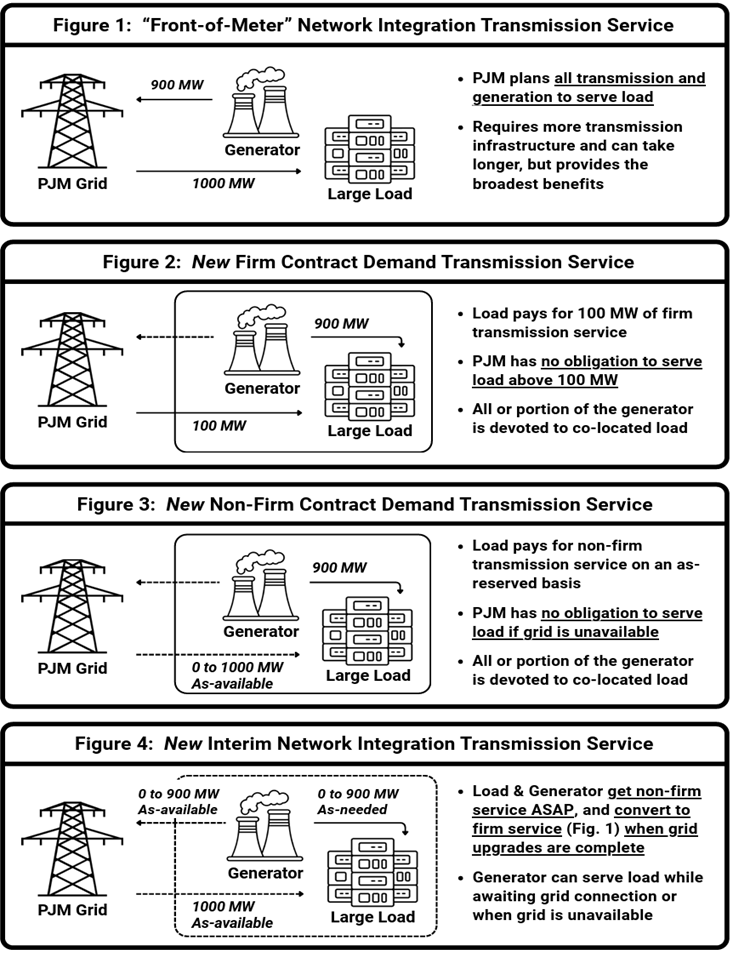
- Network Integration Transmission Service (NITS): The Commission found that Eligible Customers serving large load should have the option to continue to be treated as network loads with the right to be served from the transmission system at any time. However, the Commission found that Eligible Customers electing this option should not have the option to net out BTMG and instead will be charged for NITS on a gross basis.[30] NITS may not be combined with any other transmission service.
- Firm Contract Demand Transmission Service: Customers that are willing to limit their withdrawals from the gird would be permitted to request a new Firm Contract Demand transmission service up to a set megawatt (MW) quantity (Contract Demand). Firm Contract Demand Transmission Service would have a minimum term of one year and could be afforded a curtailment priority equivalent to firm transmission customers up to the level of a customer’s Contract Demand. Customers would have the option of combining this service with the Non-Firm Contract Demand service described below.[31] Firm Contract Demand customers would be charged for transmission, most ancillary services, and capacity based on their Contract Demand, with no adjustments if their actual usage is below their Contract Demand. Customers electing this option would be subject to penalties if they withdrew energy in excess of their Contract Demand.[32]
- Non-Firm Contract Demand Transmission Service: The Non-Firm Contract Demand Transmission Service option is primarily designed for Co-Located Loads that do not plan to withdraw energy from the grid on a regular basis. Non-Firm Contract Demand Transmission Service will allow participants to withdraw energy when transmission capacity is available and not claimed by firm customers during normal operations.[33] Customers electing this option would be required to curtail during emergency operations. Non-Firm Contract Demand Transmission Service would be available for terms ranging from one hour to one month, with customers charged for transmission and most ancillary services on an as-reserved contract demand basis.[34] Importantly, an Eligible Customer electing this service would have the option to elect to not reserve any amount of service to the extent that the Eligible Customer will not withdraw any electricity from the transmission system; in this case, the Eligible Customer would be charged for regulation and black start service (as discussed below) as well as any minimum charges established through the Commission’s paper hearing.[35] However, customers would not be allocated any capacity charges associated with their Non-Firm Contract Demand.[36]
Recognizing that one of the factors that have driven co-location arrangements is the length of time required to obtain NITS, the Commission also directs PJM to offer a new interim, non-firm transmission service for Eligible Customers that elect NITS while any network upgrades required to accommodate the request for service are being constructed. This service will be optional, transitional and limited to only Eligible Customers that have committed to taking NITS service until their Co-Located Loads can be designated as network load. While the rates, terms, and conditions of the interim service have not yet been established, Eligible Customers who opt to take such service will pay the NITS rate for the new service and certain ancillary service charges, but will avoid paying generator capacity costs in exchange for limiting their withdrawals from the system in advance of emergency conditions.[37]
The following figures—drawn from Commissioner Rosner’s concurrence—illustrate the different service offerings contemplated by the Commission’s order using the example of a 1000 MW large load customer co-located with a 900 MW generator.
b. Ancillary Services
Although the Commission finds that Co-Located Load should generally be assessed ancillary services based on its contract demand, the Commission finds that all loads should contribute to the cost of two ancillary services:
- Regulation Service: Regardless of whether a Co-Located Load draws energy from the transmission system, the Commission finds that Co-Located Load contributes to the need for regulation service because variability in a customer’s load profile can lead to moment-to-moment changes in the generator’s net output to the transmission system. Because PJM will need to use regulation service to maintain power balance within the real-time market accounting for this variability, the Commission finds that Eligible Customers taking transmission service on behalf of a Co-Located Load must be assessed charges for regulation service on a gross demand basis.[38]
- Black Start Service: FERC also finds that Co-Located Loads benefit from black start service, which is the ability of generators to start without an outside source of electricity. While certain generators co-located with load may have the ability to start without an external source of power, the Commission finds that many do not.[39] Even where a generator may have such a capability, the Commission determines that black start must be coordinated with PJM to avoid damaging the transmission system. Accordingly, the Commission finds that Co-Located Loads benefit from black start service and should be charged for this service based on gross demand.
c. Paper Hearing on Transmission and Ancillary Services
While the Commission’s order provides a blueprint for the transmission service options that should be available for Eligible Customers serving Co-Located Load, the Commission finds that the existing record does not contain sufficient evidence to allow the Commission to establish just and reasonable replacement rates, terms, and conditions for the new interim service, Firm Contract Demand Transmission Service, and Non-Firm Contract Demand Transmission Service. Thus, the Commission commences a paper hearing and directs PJM and interested parties to submit briefs addressing a range of issues related to these new services, including:
- Appropriate rates, terms, and conditions for the new transmission services.
- Whether customers electing Non-Firm Contract Demand Transmission Service should be subject to a minimum transmission service charge.
- Appropriate penalty charges and remedial actions to be taken where an Eligible Customer taking Firm or Non-Firm Contract Demand service withdraws energy from the grid in excess of its Contract Demand or reservation.
- Appropriate anti-toggling mechanisms to prevent Eligible Customers from switching between Firm and Non-Firm Contract Demand Transmission Service based on expected capacity market conditions.
- Operational requirements and practices for system protection schemes of Co-Located Loads.
- Eligibility requirements that should be necessary for an Eligible Customer to take Firm Contract Demand or Non-Firm Contract Demand Transmission Service.
- Appropriate procedures to manage curtailment during emergency circumstances.
PJM must file its initial brief in Docket No. EL25-49-000 by February 16, 2026.[40] The deadline to file responses to the brief is March 18, 2026 and the deadline for reply is April 17, 2026.[41]
3. BTMG
The Commission finds that PJM’s existing BTMG rules are unjust and unreasonable. Historically, PJM’s BTMG rules have allowed load serving entities with qualifying BTMG to net the output from generation located behind-the-meter when calculating peak demand for the purpose of calculating NITS charges. Noting that the existing BTMG rules were designed with smaller retail loads in mind, the Commission concludes that applying these rules to the large load customers that are coming online today could undermine reliability and lead to cost-shifting concerns. At the same time, the Commission acknowledges that not all customers relying on BTMG are large loads. Accordingly, the Commission directs PJM to revise its tariff to propose a new materiality threshold for the amount of load at a particular electrical location that NITS customers would be permitted to net using BTMG.[42] Although the Commission does not endorse a specific threshold, the Commission notes that PJM requires any generator larger than 10 MW to be individually metered and that the Commission’s definition of small generation is 20 MW.
Informational Filing
The Commission explains that it is encouraged by the PJM Board of Managers’ initiation of the CIFP process to address matters related to the reliable integration of large loads and the reforms that stakeholders have considered thus far as part of the CIFP process.[43] The Commission directs PJM to submit an informational report within 30 days of the order detailing the status of the various proposals being considered as part of the CIFP process, including the status of the expedited interconnection process to enable shovel-ready generation projects to serve PJM more quickly, modifications to PJM’s reliability backstop mechanism to improve PJM’s ability to respond to acute resource adequacy shortfalls, and the development of enhanced load forecasting and demand flexibility measures.[44] The Commission indicates that the informational report must address which of the initiatives being considered in the CIFP process would “support the addition, on an expedited basis, of new generation that is sufficient to serve large loads, like data centers, while meeting PJM’s near-term system resource adequacy needs.”[45] The Commission also requests that PJM explain the timing of such proposals and whether they would need to be in place prior to the 2028/2029 base residual auction.[46]
[1] PJM Interconnection, L.L.C., et al., 193 FERC ¶ 61,217 (2025) (“Order”).
[2] Order at P 1 (Rosner, Comm’r, concurring).
[3] PJM’s tariff defines Eligible Customer as “(1) any electric utility or any person generating electric energy for sale for resale, but with respect to transmission service that the Commission is prohibited from ordering by section 212(h) of the Federal Power Act, such entity is eligible only if the service is provided pursuant to a state requirement that the Transmission Provider or Transmission Owner offer the unbundled transmission service, or pursuant to a voluntary offer of such service by a Transmission Owner or (2) any retail customer taking unbundled transmission service pursuant to a state requirement that the Transmission Provider or a Transmission Owner offer the transmission service, or pursuant to a voluntary offer of such service by a Transmission Owner.” Order at P 2 n.4.
[4] Order at P 171.
[5] Order at P 173.
[6] Order at P 167.
[7] Order at P 168.
[8] Order at P 167.
[9] Order at P 169.
[10] Order at P 170.
[11] Secretary of Energy’s Direction that the Federal Energy Regulatory Commission Initiate Rulemaking Procedures and Proposal Regarding the Interconnection of Large Loads Pursuant to the Secretary’s Authority Under Section 403 of the Department of Energy Organization Act (Oct. 23, 2025), https://www.energy.gov/articles/secretary-wright-acts-unleash-american-industry-and-innovation-newly-proposed-rules (“Directive”).
[12] Order at P 175.
[13] The Commission defines Co-Located Load as a configuration that “refers to end-use customer load that is physically connected to the facilities of an existing or planned Customer Facility on the Interconnection Customer’s side of the Point of Interconnection to the PJM Transmission System.” Order at P 164.
[14] PJM Interconnection, L.L.C., 189 FERC ¶ 61,078 (2024).
[15] Order at P 226.
[16] Order at P 227.
[17] Order at P 227.
[18] Order at P 228.
[19] Order at P 228.
[20] Order at P 230.
[21] Order at P 231.
[22] Order at P 232.
[23] Order at P 233.
[24] Order at P 234.
[25] Order at P 235.
[26] Order at P 189.
[27] Order at P 189 at n.406.
[28] Order at P 177.
[29] Order at P 177.
[30] Order at P 195.
[31] Order at P 208.
[32] Order at PP 209, 212.
[33] Order at P 214.
[34] Order at P 216.
[35] Order at P 178 n.380.
[36] Order at P 218.
[37] Order at PP 201-202.
[38] Order at P 184.
[39] Order at P 185.
[40] Order at P 220.
[41] Order at P 220.
[42] Order at P 221.
[43] Order at P 237.
[44] Order at P 237.
[45] Order at P 238.
[46] Order at P 239.